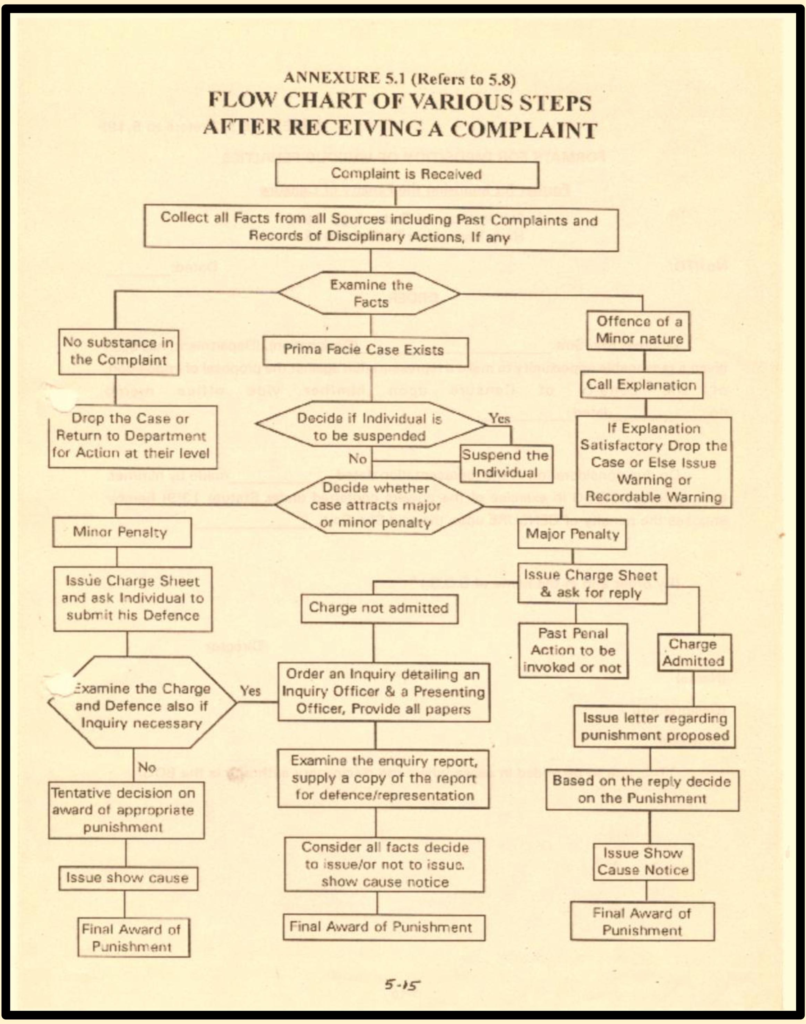
Disciplinary Actions and Rules/Penalties
The employees of the Institute are governed by the Conduct Rules as laid down in Schedule B of Statute 13(17) and all other rules as are/may be adopted after approval by the Board of Governors. Penalties, as given in Statutes 13(9) may, for good and sufficient reasons, be imposed on any member of the staff of the Institute. The Statutes of the Institute [13(9) to 13(14)] also states the manner in which these penalties can be imposed on the erring employees. The Board of Governors have also resolved that.
If, on a particular matter, no rules are provided in the Statutes of the Institute, the Govt. of India rules on the subject may be applied if they are adopted by the Board. However, in cases where the Institute feels that the Govt. of India rules on a subject need modification in view of Institute’s conditions, the Institute may frame its own rules with the approval of the Board of Governors.
Further pending amendment to the Statutes such Government of India orders which are considered more appropriate than the existing provisions in the Statutes and which are adopted by the Board of Governors, be implemented in the Institute.”
These conduct rules may, therefore, be applied in conjunction with Central Civil Services
(Conduct) Rules and Central Civil Services (Classification, Control and Appeal) – CCS(CCA) Rules.
The Board of Governors has also approved that CCS (CONDUCT) RULES 1964, CCS(CCA) Rules 1965, Fundamental & Supplementary Rules, Medical Attendance Rules, General Financial Rules, as applicable to the employees of Govt. of India from time to time be adopted in so far as they are not inconsistent with the Act/Statutes and decisions of Board of Governors (BOG), so that the relevant rules and provisions are made applicable to the employees of the Institute with reference to their service conditions and powers vested in the different authorities of the Institute under Statutes. It is also proposed that if any question arises relating to interpretation of these rules or relevancy of these rules, it shall be referred to the BOG whose decision thereon shall be final.
Leave to Emeritus Fellows/Chair Professors/Whole- time Visiting Professors/Faculty
Emeritus Fellows/Chair Professor/Whole-Time visiting Professors/Faculty serving the Institute are allowed to avail Vacation/Earned/Casual Leave as admissible to regular faculty members of the Institute except that such Leave (s) shall lapse at the end of the year and no carry forward/encashment etc. for the same shall be admissible.
*Note- Leave to be applied through Institute’s Online ERP Portal
Summary of Faculty Conduct Rules:
https://estb.iitd.ac.in/RulePosition/Faculty/Conduct.pdf
Disciplinary Authorities:
- The following are the disciplinary authorities for the various categories of staff:
- Director: In the case of non-academic staff (except Group A).
- Board of Governors: In the case of all academic and Group-A Officer.
- Appellate Authorities
The following are the appellate authorities: - Board of Governors: In the case of any penalty imposed by the Director. There is no further appeal in the decision of the Board in such cases.
- Visitor: In the case of a penalty imposed by the Board.
List of Penalties
The penalties that can be imposed are listed in Statutes 13(9) and are given below:
- Censure.
- Withholding of increments or promotion.
- Recovery from the employee, the whole or part of any pecuniary loss caused to the Institute by him by negligence or breach of orders.
- Reduction to lower service, grade or post or to a lower timescale or to a lower stage in a timescale.
- Compulsory retirement.
- Removal from service, which shall not be a disqualification for future employment in the Institute.
- Dismissal from service which shall ordinarily be a disqualification for future employment in the Institute.
*NOTE: Warning, admonition, reprimand, caution and displeasure are not formal punishments/penalties.
Disciplinary Proceedings
There are two basic differences between the penalty proceedings for penalties listed at: Serials (i) to (iii) and for penalties at Serials (iv) to (vii) above
*NOTE: As per the ruling of the Supreme Court of India, if Withholding of increments or promotion is with cumulative effect, it will be treated as a penalty falling along with Serials (iv) to (vii).
- The penalty at serials (iv) to (vii), at para 5.5, are termed as Major penalties and for these penalties formal charges should be drawn up, which should be supported by detailed statement regarding Imputations, List of Witnesses and List of Documents. The penalty at serials (i) to (iii) at para 5.5 are termed as Minor penalties and for such proceedings, the Statement of imputations of charges are sent to the delinquent official.
- In Major penalty proceedings all relevant documents are allowed to be inspected by the Delinquent Officer. In minor penalty proceedings, it is not necessary that the documents should be shown to him. However, if the case against him is itself based on documents (for example he is charged with interpolating some documents), then it would be unfair to deny him access to those documents.
Suspension
The Director may place a member of the staff appointed in the Institute under suspension:
- Where a disciplinary proceeding against him is contemplated or is pending.
- Where a case against him in respect of any criminal offence is under investigation or trial.
Where however a member of the staff is detained in custody for a period exceeding forty-eight hours, whether in connection with a criminal offence or under any law for time being in force providing for preventive detention, such member of the staff shall be deemed to have been placed under suspension with effect from the date on which he was so detained.
An employee under suspension is regarded as subject to all other conditions of service applicable generally to employees and cannot leave the Station without prior permission of the Institute authority.
Suspension should not be for an indefinite period. It should be reviewed after 90 days (initially) and then after another 180 days.
CCS Rules VIS-A-VIS Statues on Penalties
Censure
This is covered under CCS/CCA Rule 11(I).
According to GOI instructions, an order of “Censure” is formal and public act intended to convey that the person concerned has been guilty of some blameworthy act or omission for which it has been found necessary to award him a formal punishment, and nothing can amount to a ‘Censure’ unless it is intended to be such formal punishment and imposed for “good and sufficient reason” after following the prescribed procedure. A record of ‘Censure’ should be kept in the employee’s Confidential Report dossier.
With holding of Increments or Promotion – The withholding of increments is covered under CCS(CCA) Rules 11(iv) and withholding of promotion under Rule 11(ii).
According to CCS(CCA)Rule 16, minor penalties are to be imposed after giving reasonable opportunity of making representation, and holding an inquiry if such withholding of increments is likely to affect adversely the amount of pension payable to the employee or withholding increments of pay for a period exceeding three years or withholding of increments of pay with cumulative effect for any period.
Recovery from the whole or part of any pecuniary loss caused to the Institute by negligence or breach of order. This penalty can be imposed only when it is established that the employee was responsible for an act or acts of negligence or breach of orders or rules and that such negligence or breach caused the loss.
Recovery from pay as a punishment for any pecuniary loss caused by negligence or breach of orders should not exceed one-third of basic pay (i.e. excluding dearness pay or any other allowances) and should not be spread over a period of more than three years)
Reduction to Lower Service, Grade or Post or to a Lower Timescale or to Lower Stage in a Time Scale.
Reduction to lower service, grade or post or reduction to a lower timescale has been dealt with in GOI instructions under CCS Rule 11. According to this: –
- Every order passed by a competent authority under Sub-rule (1) and (2) of Fundamental Rule 29 imposing on a government servant the penalty of reduction to a lower service, grade or post or to a lower timescale should indicate:
- The date from which it will take effect and in case where the reduction is proposed to be imposed for a specified period (in terms of years and months) for which the penalty shall be operative.
- The extent (in terms of years and months), if any, to which the period referred to at item (i) shall operate to postpone future increments on restoration after the specified period. The period specified under this subclause shall in no case exceed the period specified under sub-clause (i) above.
- The stage in the time scale to which the employee is reduced. It should be noted that reduction to a lower stage in a time scale is not permissible under the rules for an unspecified period or as a permanent measure. Also when an employee is reduced to a particular stage, his pay will remain constant at that stage for the entire period of reduction. The period to be specified under (iii) should in no case exceed the period specified under (i) above.
Process of Imposing various Penalties